
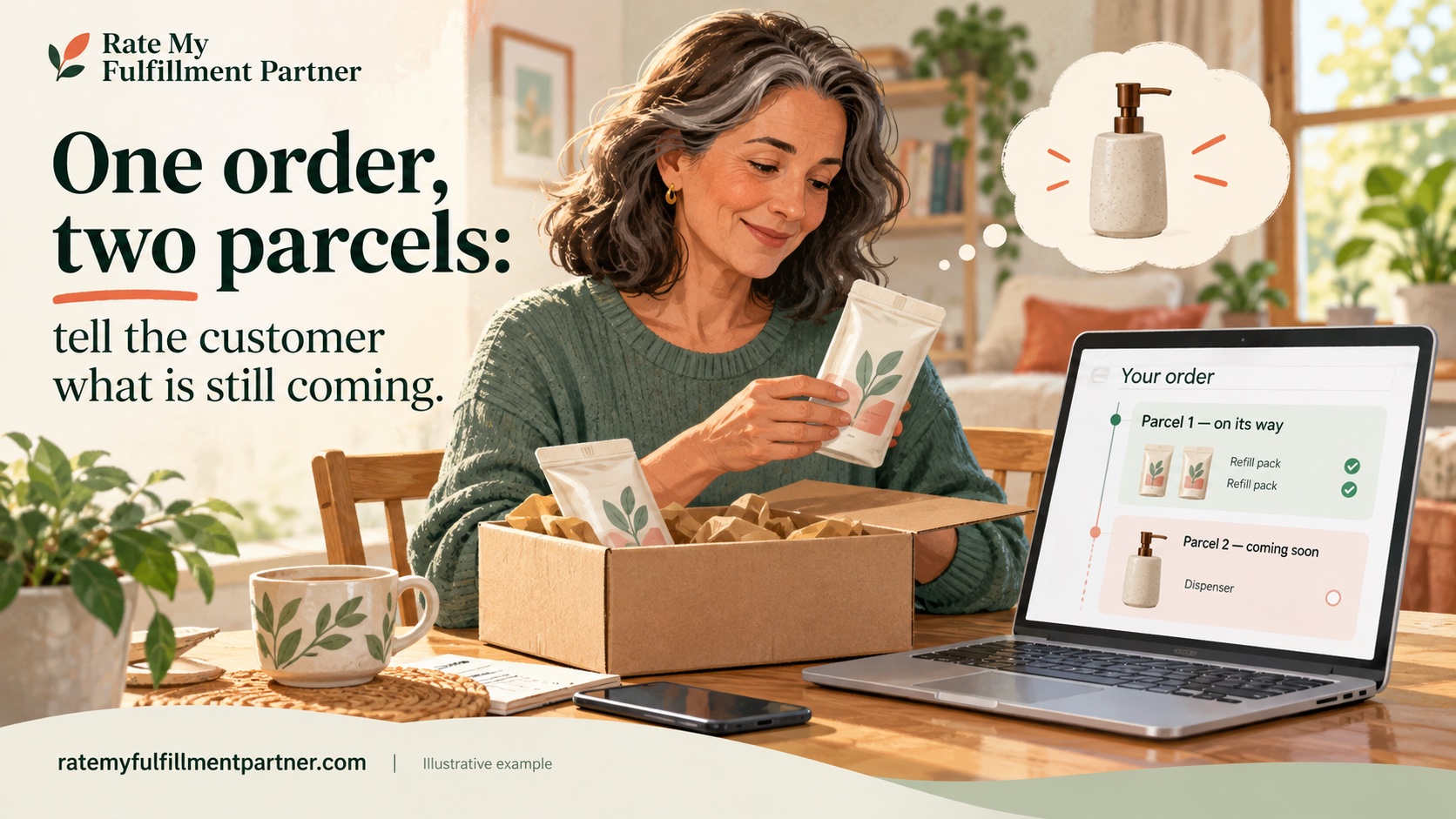
The first parcel arrives. The customer opens it, finds half the order and assumes something is missing. The warehouse may have done exactly what was planned, yet the customer still has a problem: nobody explained the rest of the delivery.
Treat a split order as several promises that must remain visible together. The goal is a clear answer to “What is still coming?” without requiring the customer to understand your warehouse arrangement.
Check what the customer actually saw
Shopify documents checkout support for multiple shipments and shipment-level options, but notes compatibility limits and possible third-party fulfillment-app issues. A checkout display alone does not confirm that later messages will preserve the same detail. Shopify split shipping documentation.
Ask your team to keep the checkout confirmation, dispatch message and order-status view from one controlled test. Compare the item list across all three. Do not assume that enabling a setting verifies the whole customer experience.
Keep the outstanding items in the message
Our proposed update contains four pieces of information: items and quantities in this parcel, the shipment reference, the current event and the next step for anything outstanding. Use ordinary product names the customer recognizes.
An illustrative message might say: “Your two refill packs are in this shipment. The dispenser is being prepared separately. We will update you by Tuesday afternoon if its dispatch plan changes.” Use that wording only when the information and promised follow-up are supported by your operation.
A label-created event should not become a confident delivery promise. Have the team agree which event permits each phrase before writing templates.
Rehearse three different endings
We designed three hypothetical cases to check whether a shared support process can explain the order. No actual customer incidents were studied.
| Case | Customer needs to know | Internal decision |
|---|---|---|
| Both parcels have dispatched | Which items belong to each tracking reference | Confirm both references remain accessible |
| Only one has dispatched | Which items remain outstanding and the next update | Assign someone to obtain the dispatch plan |
| Remaining items are canceled | What will no longer arrive and what resolution is approved | Confirm the authorized refund or other remedy |
The third case matters because a generic “another parcel is coming” message becomes wrong after cancellation. Name the person who updates the customer when the plan changes.
Give support an order-level view
Ask the 3PL to supply shipment details in a format your support team can connect back to the original order lines. Keep one owner for the conversation, even if two locations or systems contribute records.
For the controlled test, let someone unfamiliar with the order answer three questions using only the customer-facing material: what arrived, what remains and when to expect another update. Record confusion as a test result rather than treating it as a training failure.
Agree on completion
An order should not be described as complete merely because one tracking reference says delivered. Define how all lines are resolved and how canceled or substituted items are explained. This is our recommended communication control, not a claim about a platform's automatic behavior.
A clear parcel-by-parcel explanation gives support something useful to say before the customer has to ask twice.
Continue reading
Source and research scope
- Shopify split shipping documentation — accessed September 28, 2026.
Created three hypothetical shipment-outcome cases and a four-field communication checklist; checked one official platform source for scope and integration limits. No provider winner is established.