
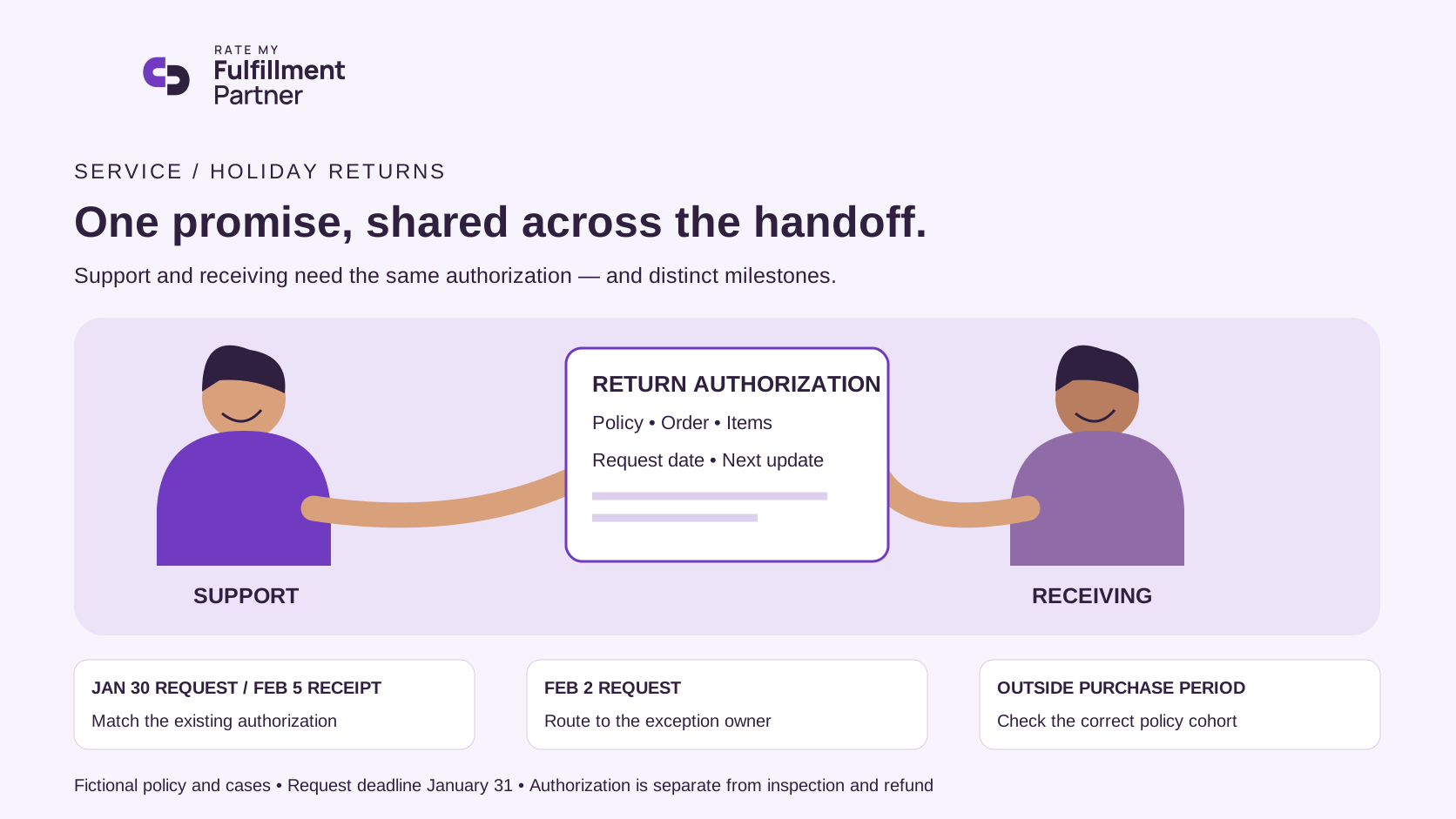
The customer hears one promise
“Holiday returns accepted through January” sounds simple until a customer asks for a return in January and the parcel reaches the warehouse in February. Support may see an approved request while a receiving operator sees an old purchase. Both teams can follow their own instructions and still leave the customer waiting.
Treat a seasonal extension as a shared operating decision. It needs an effective purchase period, eligible products, a deadline event and an exception owner. A banner alone does not provide those instructions.
Shopify’s return-rule documentation distinguishes return windows from other return settings and describes different starting events and product overrides. Those settings are platform behavior, not proof that a warehouse has received or implemented your policy. Check the actual configuration and the instructions used by your 3PL separately.
Walk three cases through one proposed policy
For this desk exercise, we invented a policy: qualifying purchases from November 1 through December 24 may request a return through January 31. This is an operational example, not recommended legal wording. We assume approved requests receive a return authorization and a separate send-by instruction. Product condition and refund decisions remain separate reviews.
| Fictional case | Request and receipt | Handoff decision under the assumed policy |
|---|---|---|
| Eligible purchase; request January 30 | Warehouse receives February 5 | Match the authorization; do not reject solely because receipt is in February |
| Eligible purchase; request February 2 | No existing authorization | Route to the named exception owner before promising an approval |
| Purchase outside the promotional period | Request January 20 | Apply the correct purchase cohort, not the holiday banner alone |
These are three contrasting paper cases, not customer records or a warehouse test. Their purpose is to reveal which event each team uses. The first case exposes receipt-date substitution; the second tests exception ownership; the third tests whether support can identify the qualifying purchases.
Write the handoff in language people can use
Give support a short decision record: order reference, policy version, eligibility outcome, authorization identifier, customer instruction and promised next update. Give receiving the authorization identifier, expected items, approved intake route and hold instructions for mismatches. Avoid making an operator reconstruct the original customer conversation from a shipping label.
Agree what “accepted” means in each message. It might mean a request was authorized, a parcel was received or the item passed inspection. Those are different milestones. Tell the customer which milestone has occurred and what remains to be checked before a refund or replacement decision.
A helpful internal instruction is: “Receive and record this authorized parcel; refer any product or authorization mismatch to the returns owner.” The final wording must fit your actual policy and system. Do not ask receiving staff to improvise exceptions from a marketing promise.
Give the exception queue a person and a clock
Name a primary owner and a backup for requests that do not fit the published rule. Define the information needed to decide and the next customer-update time. If a return is waiting for brand approval, make that status visible to the account manager rather than leaving it labeled simply as processing.
Before launch, ask the 3PL to walk through the three cases with you and identify the screen, document or queue used at each handoff. Record whether the answer was described or demonstrated. No demonstration has been performed for this article.
After the promotion, review a small, deliberately selected set of exceptions across these categories. Look for inconsistent event definitions before blaming either team for slow service. A clear holiday promise is one that support can explain and the warehouse can carry through to a documented outcome.
Further reading
Sources
- https://help.shopify.com/en/manual/fulfillment/managing-orders/returns/return-rules — accessed 2026-10-30.