
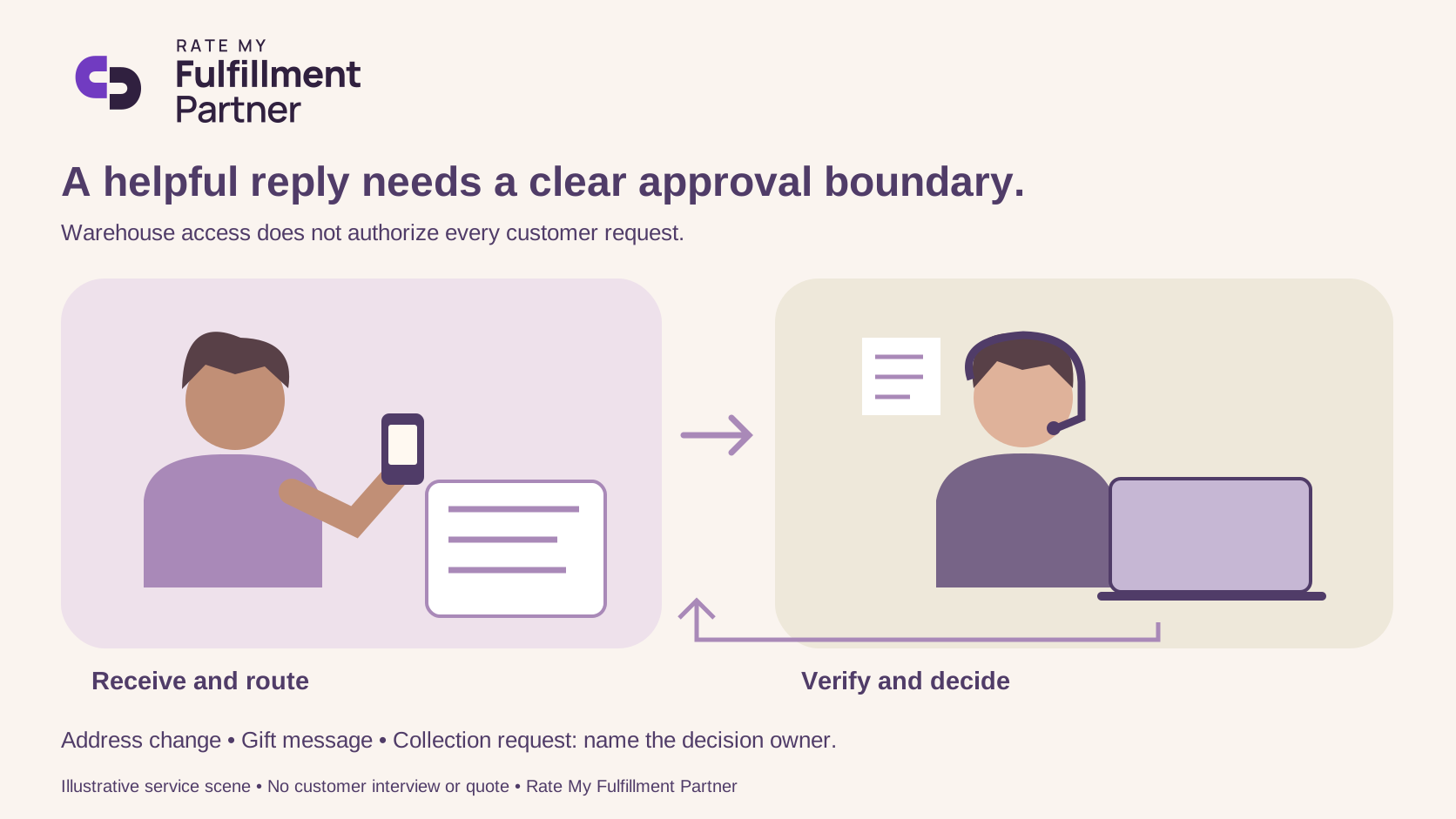
A helpful reply can create an unintended promise
A customer finds your warehouse's contact details and asks it to send an order to a different address. The request sounds simple. The warehouse can see the order. Someone wants to help. But the person replying may not have the brand's process for verifying the requester or deciding whether the change is appropriate.
This is a service-design question to settle before it becomes an urgent exception. Customers should not be bounced between companies, and warehouse staff should not have to invent your customer-care policy.
Distinguish access from approval
Shopify separates permission to manage order information, including shipping information, from permission to add or remove order line items. These settings describe what a user can do in that platform. They do not establish that a particular incoming customer request has been verified or approved. Shopify store permissions.
Ask the fulfillment partner two different questions: who can make the change in its systems, and whose instruction allows them to do it? A useful answer names both roles. If the 3PL provides contracted customer service as well as warehousing, document the delegated decisions explicitly rather than assuming every warehouse employee has the same authority.
Walk through three requests before onboarding
For this desk exercise, we constructed three situations. They are proposed discussion cases, not results from customer interviews or provider testing.
| Direct request | First response to agree | Decision owner | Evidence that closes the loop |
|---|---|---|---|
| Change the delivery address | Acknowledge and route to the brand's approved verification channel | Authorized customer-care role | Approved address version and warehouse acceptance |
| Add a gift message | Record the requested wording without promising inclusion | Role delegated to approve presentation changes | Accepted packing instruction or clear explanation that the cutoff passed |
| Collect the order at the warehouse | Explain that collection needs confirmation | Brand and warehouse roles responsible for collection | Approved appointment and release procedure |
The third case matters even when the parcel has not been packed. An order's presence in a warehouse does not by itself establish that the location supports customer collection. Treat the walkthrough as a way to discover the service boundary, not as an instruction to offer pickup.
Give the customer one continuing conversation
Agree who owns the reply after the request is handed off. A warm acknowledgment can say that the request has reached the team responsible for checking it and that the change is not yet confirmed. Use your own response-time commitment; do not manufacture one because the customer contacted a different inbox.
Pass the request reference and original message internally so the customer does not have to repeat everything. Share only the information needed for the assigned action. The warehouse's completion note should identify what it accepted, when, and any remaining limitation. Customer care can then explain the outcome accurately.
If the request arrives after the warehouse can safely change the order, the answer should distinguish the rejected change from the original shipment's status. Otherwise, a customer may interpret 'we could not update it' as 'we stopped it.'
Evaluate the handoff, not the friendliness alone
Ask prospective partners to describe these cases using their actual escalation roles. Look for a clear owner, an authorization check and a final response. A cheerful first reply is useful, but the relationship is more dependable when everyone understands what that reply commits them to.
The three-case analysis shows why one catch-all rule is inadequate: an address change, a presentation request and a collection request involve different decisions. The framework is editorial guidance, not a security audit or an assessment of any provider.
Related reading
Sources
- Shopify Help Center: Store permissions — accessed November 6, 2026.