
Start with the list behind the percentage A review call can get stuck when a brand sees late customers and its account manager sees a strong service score. Before debating whether the percentage is good enough, ask for the orders and rules behind it. Both teams may be describing the same week with different boundaries.
Shopify distinguishes order, payment, fulfillment and return statuses. Its documentation also separates a fulfillment hold from a partly fulfilled order and from a scheduled fulfillment. These distinctions help organize an order list, but they do not define your provider's service agreement. Shopify order statuses.
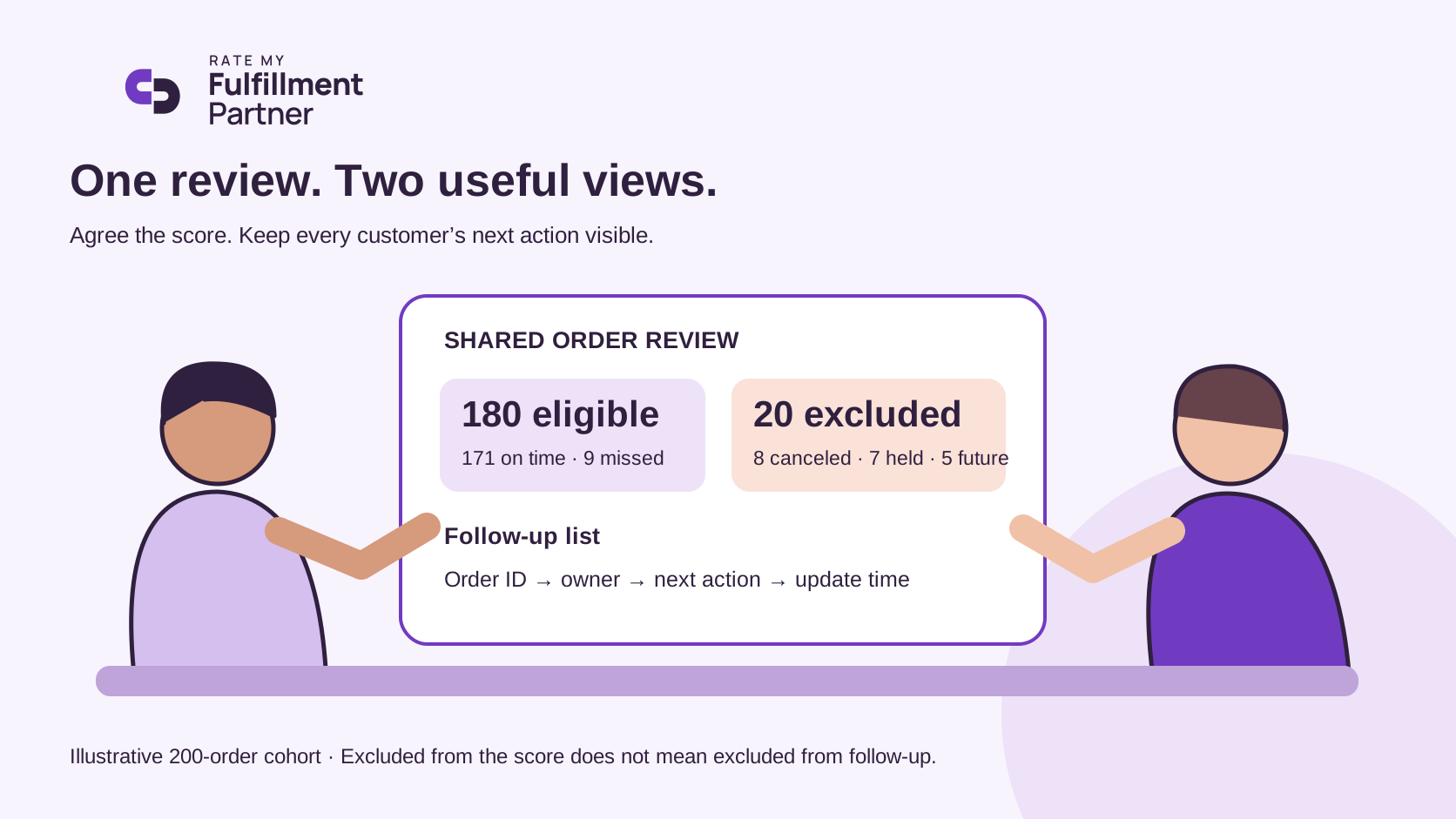
Reconcile a deliberately simple week We built one hypothetical cohort of 200 orders. The categories below are mutually exclusive at a stated review cutoff. The invented agreement counts only released, eligible orders due for dispatch in that period. It excludes the other three categories for this exercise; real contracts may differ.
| Cohort category | Orders | Treatment in this example |
|---|---|---|
| Eligible and dispatched by the agreed deadline | 171 | On-time numerator and eligible denominator |
| Eligible but not dispatched by that deadline | 9 | Eligible denominator only |
| Customer cancellation before release | 8 | Excluded from dispatch score |
| Brand-imposed hold before release | 7 | Excluded; still needs an owner |
| Future scheduled release | 5 | Excluded until its release window |
| Total | 200 | Reconciliation control |
The dispatch score is 171 divided by 180, or 95%. Dividing the same 171 by all 200 gives 85.5%. That second figure is simply the share of the full cohort dispatched by the cutoff. It is not a corrected version of the contractual score. The difference comes from denominator choice, not evidence of dishonesty.
Do not lose the people outside the score The seven held orders still represent customers. Someone needs to explain the hold, resolve its cause and tell support when the order becomes eligible. The five future releases may be progressing normally, provided the promised schedule is clear. The eight cancellations may need a separate refund check.
A good account review therefore keeps an eligible-order score alongside an exception list. The exception list should have order ID, reason, responsible team, next action and next update time. It need not imply that every exception is a warehouse failure.
For the nine missed eligible deadlines, ask which cases share a cause and which need individual recovery. A percentage alone cannot tell support whether two missed orders belong to one customer or whether the remaining stock can ship today.
Agree the clock before exporting the report Specify the deadline timezone, order eligibility timestamp and report cutoff. Choose whether the measurement unit is an order, shipment or order line. Record how split shipments are treated. Preserve the export used for the review so later status changes do not silently rewrite the discussion.
An exclusion should carry a reason and timestamp. A hold entered after an agreed deadline deserves review; its current status alone does not explain whether the earlier deadline was missed. Likewise, cancellation before release and cancellation after a long delay should not be treated as interchangeable facts.
Use the conversation to assign work Ask your account manager to reconcile a small set of disputed IDs with your support lead. Agree on corrections to the report and separately agree on customer actions. End the meeting with named owners for both. This makes the review useful even when the contract score itself is calculated correctly.
Our example is a desk exercise, not a measurement of a provider or an industry benchmark. Its mutually exclusive categories are intentionally simple. With real exports, deduplicate IDs, document overlaps and apply the actual agreement before comparing periods or companies.
Further reading
Sources
- https://help.shopify.com/en/manual/fulfillment/managing-orders/order-status — accessed 2026-10-29.