
Give the meeting a job
A service review can contain a correct dashboard and still leave everyone unclear about Monday morning. The brand asks for improvement, the account manager promises attention, and the next meeting begins with the same slide.
Try bringing a decision record instead. Its job is to separate an observed problem, an unproven explanation and an approved next step. That distinction makes it easier to work with your fulfillment partner without asking either team to pretend the cause is already known.
ASQ describes the plan-do-check-act cycle as a repeating approach to change: plan, test on a small scale, review the results and act on what was learned. The meeting tool below is our editorial adaptation for a brand and a 3PL. It is not an ASQ certification scheme or evidence that any provider follows the process.
A worked service-review record
Consider a fictional brand whose gift messages have been omitted from several orders. No actual customer records were reviewed for this example. The meeting starts with three possible responses:
| Proposed response | What is missing | Decision the teams can make |
|---|---|---|
| “Remind everyone to be careful” | Defined change and check | Replace with a specific instruction trial |
| Change every packing station immediately | Evidence the new instruction helps | Limit the first trial to an agreed scope |
| Check one shift’s eligible gift orders under a revised instruction | Owner, evidence and review date still needed | Approve only after filling those fields |
The third response is easier to evaluate because it has a boundary. It is not automatically the correct operational fix. If the message never reaches the warehouse system, a packing instruction may not address the cause at all. First verify where the required information is lost.
Write the fields that prevent a second vague meeting
Record the affected order type, the observed issue and the supporting order references. Keep customer details in the appropriate controlled systems; the meeting note can refer to those records without reproducing unnecessary personal information.
Next, record the hypothesis and the proposed change separately. For example: “The message field is visible but is being missed” is a hypothesis. “Move the message check before carton closure on one agreed shift” is a proposed action. The provider should confirm whether that action is practical and whether it affects other controls.
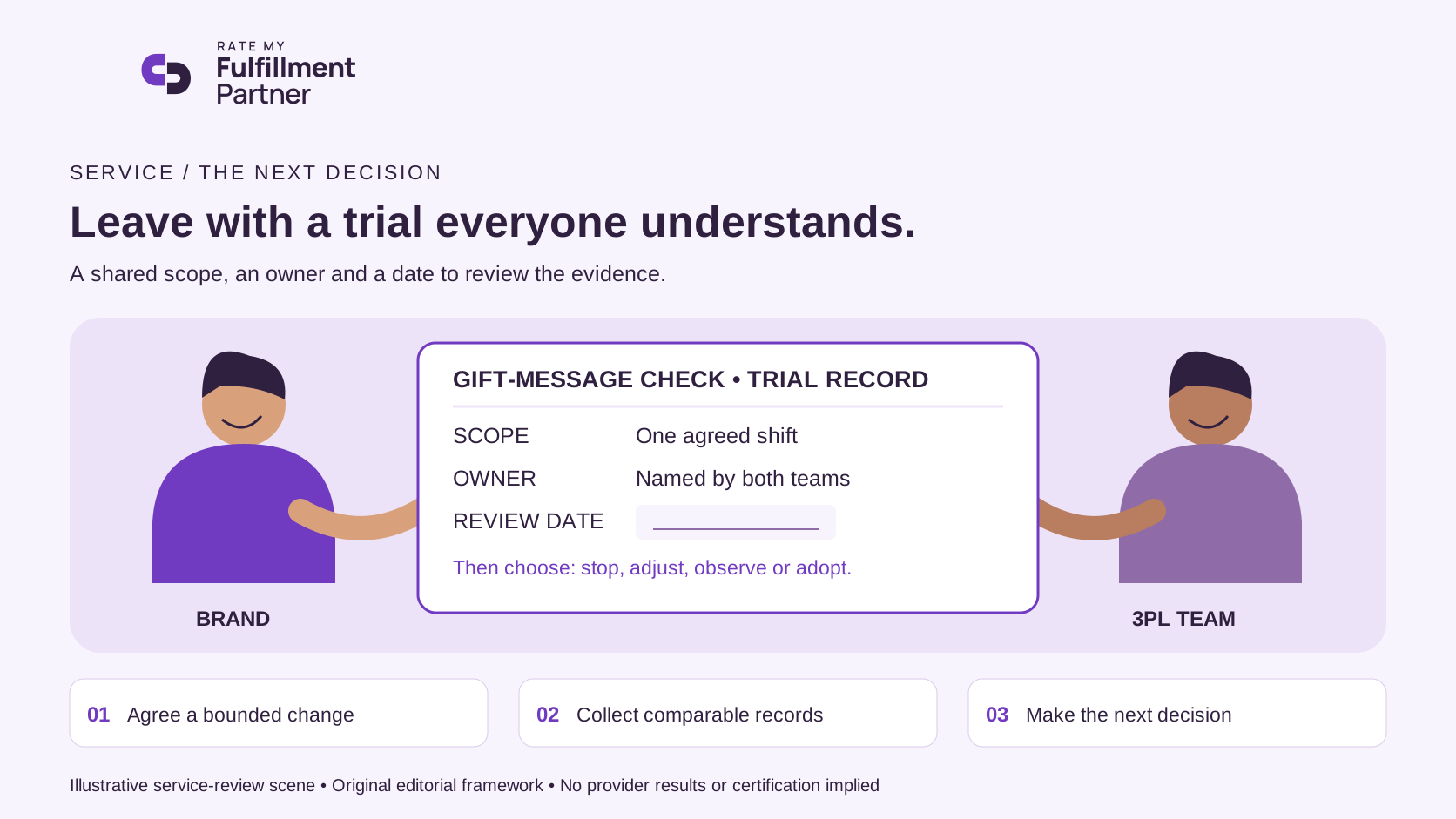
Name the person authorized to approve the trial, the person implementing it and the person reviewing the evidence. One person may hold more than one role, but do not leave the roles implicit. Include the start, end and review dates, plus what should happen if the trial causes another problem.
Decide what the evidence can support
Our invented review has 40 eligible orders before a change, with four recorded omissions, and 40 after, with one. That is 10% versus 2.5%, a 7.5-percentage-point difference in these constructed records. It is not a measured provider result and does not establish that the change caused an improvement.
The decision record should ask whether order types, shifts and recording practices were comparable. A small favorable sample can justify further observation; it does not justify an unconditional performance promise. Missing records should remain missing, rather than being quietly counted as successful orders.
Close with a choice and a next check
End the meeting by recording whether to stop the trial, adjust it, continue gathering evidence or adopt it more widely. If adopted, assign responsibility for updating the working instruction and briefing the people who use it. Keep the earlier version identifiable so a later question can be traced to the instruction in effect.
A supportive relationship does not require accepting “we’ll keep an eye on it” as the final action. It requires a shared, manageable next step. When choosing a 3PL, ask how that provider would run this conversation and what written record your team would receive afterward.
Further reading
Sources
- https://asq.org/quality-resources/pdca-cycle — accessed 2026-10-31.