
“The warehouse is running again” is only part of the answer
When one operational problem affects many orders, support teams need a shared explanation. They also need to know what happened to each customer's purchase. Those are two different records.
A restored packing process may leave orders waiting for stock, a cancellation confirmation or a shipping decision. Closing every customer conversation when the incident closes can hide those remaining obligations. Agree with your 3PL on a common incident owner and a separate order-level follow-through process before the next disruption.
A six-order tabletop example
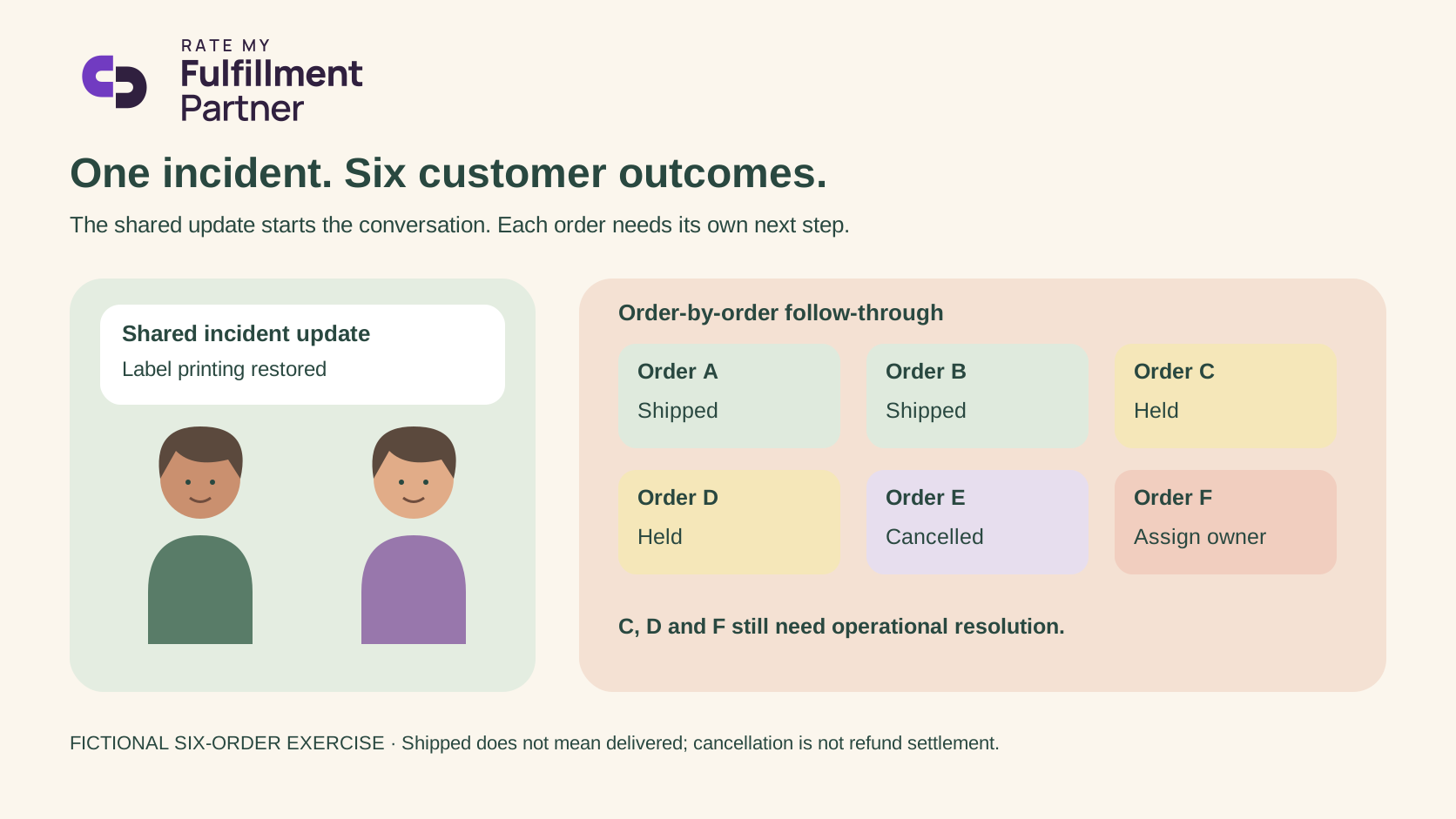
This is a fictional exercise, not a report of customer incidents. Assume a label-printing interruption has ended and six affected orders have been checked.
| Orders | Current evidence | Next customer action |
|---|---|---|
| A and B | Shipment confirmed | Give each customer the relevant tracking update |
| C and D | Still held for an order-specific issue | Explain the hold and next decision time |
| E | Cancellation confirmed | Confirm the cancellation; check any refund action separately |
| F | No verified owner or next action | Assign an owner and investigate before promising shipment |
Two orders shipped, two remain held, one has a confirmed cancellation and one remains unassigned: 2 + 2 + 1 + 1 = 6. Three orders still need operational resolution. The incident may be recovered while those three remain open.
Even “shipped” does not mean delivered, and a confirmed cancellation does not establish that a refund has settled. Use precise milestones instead of one broad resolved flag.
Share facts once, decide outcomes individually
The shared incident record should contain a stable identifier, the confirmed issue, affected time window, recovery status, owner and next update time. Link affected orders to it. Avoid copying customer addresses or payment details into a general incident broadcast.
Each order record should separately identify its current state, evidence timestamp, responsible person, action due and customer message status. If the affected population changes, reconcile additions and removals rather than quietly replacing the original count. Keep an explanation for an order removed as unaffected.
This is our recommended operating framework, not a claim that a particular help desk performs the linking automatically. Confirm your systems and permissions support the workflow.
An internal note is not a customer update
Shopify documents that Timeline notes and comments are internal and not visible to customers. Recording a warehouse explanation there therefore does not, by itself, notify the buyer. The same practical question belongs in any system review: where is the evidence that an approved message was actually sent?
For the example's held orders, an illustrative message is: “The label issue has been resolved. Your order still needs a separate inventory check. We will update you by the agreed time, even if that check is still open.” Replace the vague time reference with a specific date, time and time zone in a real message. Do not claim a shipping date without supporting evidence.
Close two loops
Ask the 3PL to close the operational incident with a factual recovery note. Ask your support owner to close the affected-order list only after every row has a verified disposition and the appropriate customer follow-up. Some rows may transfer to a separate claims or refund workflow; record that transfer and its owner.
Our six-order exercise shows why a single recovery message cannot establish six customer outcomes. It does not measure support quality or prescribe a universal response deadline. The practical buying question is whether your prospective partner can provide order-level evidence after the headline problem is fixed.
Related reading
Sources
- Primary source 1 — accessed 2026-10-27.