
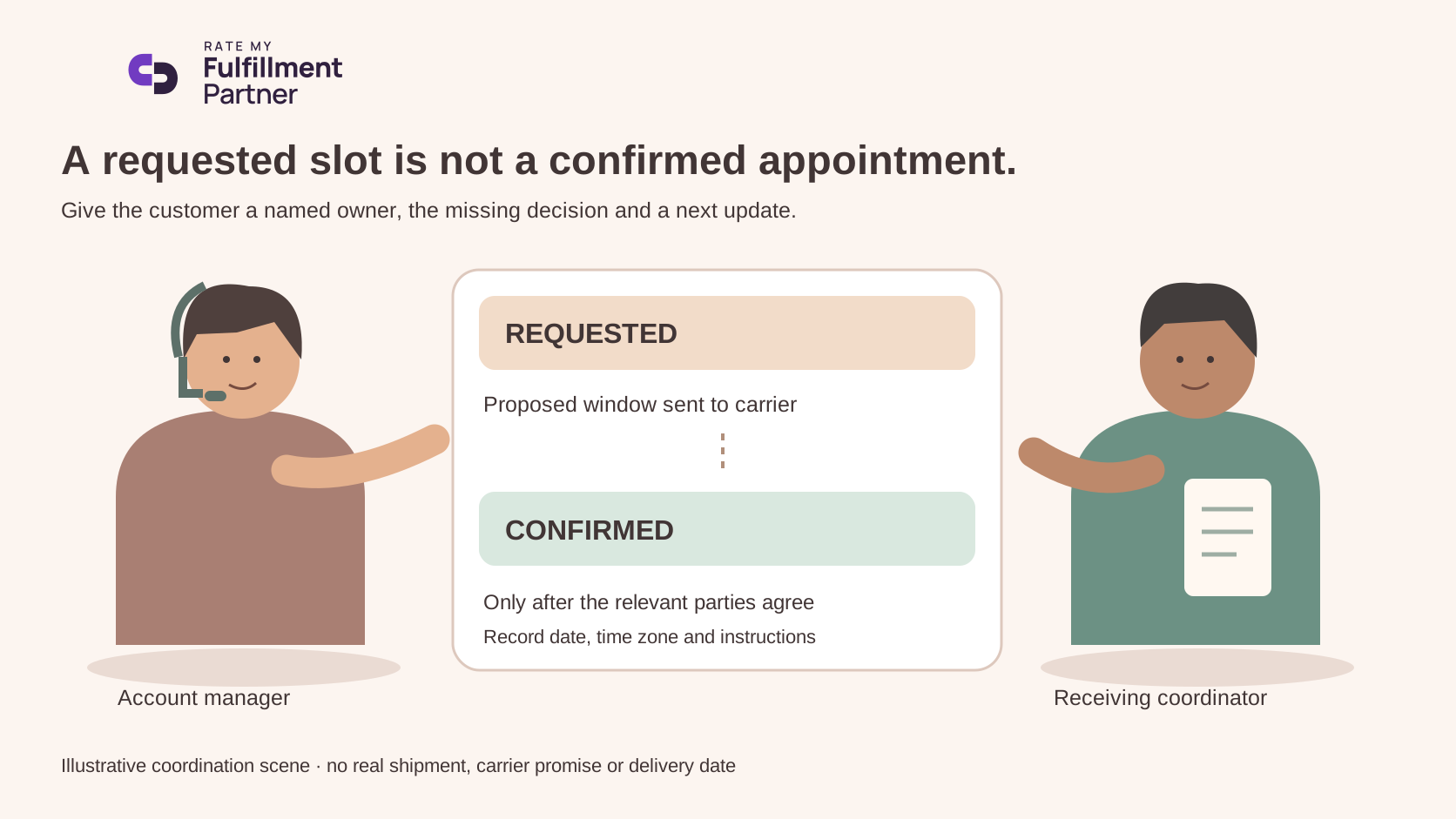
“We are working with the carrier” can be a reasonable first response to a freight delay. It becomes frustrating when the customer still does not know whether to keep a receiving team available tomorrow. The account manager's job is to turn that uncertainty into a clear coordination task.
For a brand using a 3PL, there may be several parties: the warehouse, the transport account holder, the carrier and the receiving business. Decide who talks to whom before sending a promise. The person answering the customer may coordinate the work without having authority to book the vehicle or accept new charges.
Read the event before interpreting it
The FedEx Freight delay-code legend distinguishes an appointment requirement, an attempted delivery, a consignee refusal and a shipment held for disposition instructions. Those labels describe different situations. An appointment requirement alone does not confirm a booking, and an attempted delivery does not establish that the receiver refused it.
The legend is a carrier-specific source, not a universal dictionary. Check the actual carrier's record and explanation. Our communication framework below is editorial guidance; it does not change a carrier's service terms, fees or booking process.
Three situations, three different conversations
We mapped three fictional freight statuses to a next action and a statement the brand should avoid making without more evidence. No live shipment was investigated.
| Observed situation | Information to obtain | Do not yet promise |
|---|---|---|
| Appointment required | Receiver availability, booking contact and carrier confirmation | A particular delivery slot |
| Delivery attempted | Attempt details, receiving constraints and the next booking step | That the recipient refused the freight |
| Held for disposition | Authorized instruction, its recipient and acknowledgement | That redelivery is scheduled |
This map keeps a missing decision from becoming a vague delay. If the receiver has not supplied an acceptable window, say so respectfully and offer a way to provide it. If the carrier has not confirmed the proposed window, keep the booking described as requested.
Write an update that someone can act on
An illustrative update might read: “The carrier record says an appointment is required. Our transport coordinator has requested Tuesday morning using the receiving contact you supplied. That slot is not confirmed. We will update you by 3 p.m. Eastern today, including if we are still waiting. Please tell us if the receiving team cannot accept Tuesday morning.”
The times and people in that example are fictional. The useful elements are the current evidence, the action already taken, the remaining uncertainty and the next update commitment. A good update does not require inventing a delivery date.
Keep commercial decisions separate. If rebooking may involve storage, redelivery or other charges, ask the transport account holder for the applicable terms and estimate. Record who can authorize that cost. Do not tell the customer a fee is waived or inevitable before the responsible party confirms it.
Close the booking loop, then the delivery loop
A confirmed appointment should identify the shipment, receiving location, date, local time zone and any instructions accepted by the relevant parties. Send the same confirmed facts to the people who need them. If someone proposes a change afterward, make clear whether the previous slot still stands.
Booking is an intermediate milestone. Delivery evidence is a separate one. Agree what confirmation the brand will receive after the event and who will investigate a mismatch between the expected and actual receipt. A closed support ticket should not be the only record that a receiving problem was resolved.
When evaluating a fulfillment partner, ask it to walk through this handoff using a fictional shipment. Look for a named coordination owner and a clear boundary between a request, an acknowledgement and a confirmed outcome. That makes the relationship easier to manage even when a carrier cannot immediately provide the answer everyone wants.
Further reading
Use our 3PL selection guide to build the shortlist and fulfillment pricing guide to compare the scope of each offer.
Sources
Research accessed 2026-11-18.
- https://www.fedexfreight.fedex.com/delay_codes.jsp
Research method and limitations
Mapped three carrier-described status categories to original communication actions and prohibited inferences; wrote a fictional update. No transit, support-response or provider test. Original calculations and proposed controls are editorial desk analysis. No interviews, surveys, firsthand provider testing or provider responses occurred. Unknown capabilities and account-specific terms remain unknown.