
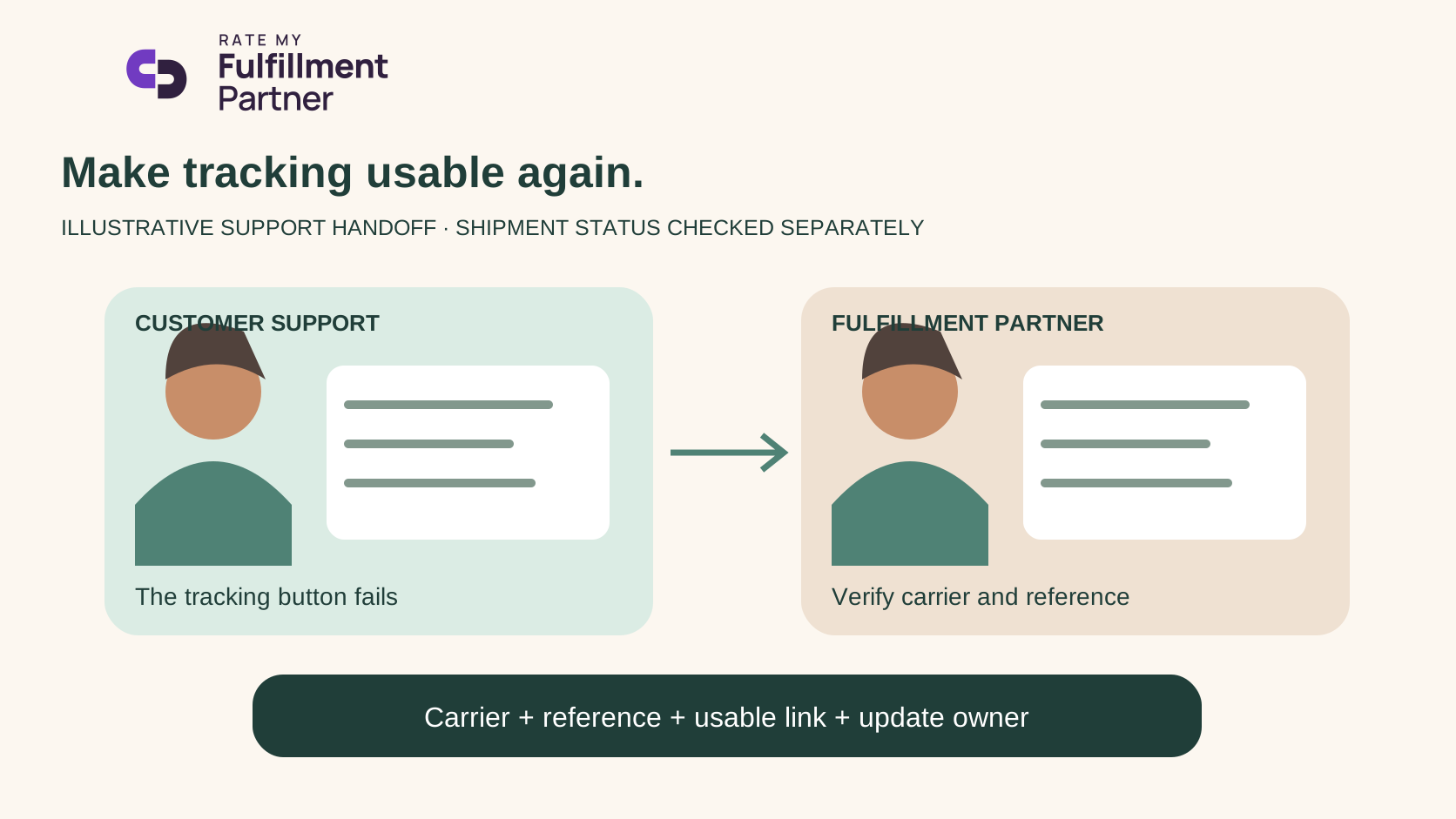
“Your order has shipped” is not much help when the button underneath opens an error page. The customer has a practical problem: they cannot see where the parcel is or what to do next. A good fulfillment relationship gives the brand a way to solve that problem without making the customer diagnose the integration.
Start by separating the customer-visible link from the shipment itself. A broken link does not establish that a parcel is lost. A working link does not establish that it has moved. Your support conversation needs both a usable access route and an honest description of the evidence available.
Agree what the 3PL hands over
Ask for the carrier name, tracking reference, tracking URL and the order or shipment that the reference belongs to. Those fields should travel together. A number without its carrier can be ambiguous to the system receiving it.
Shopify's tracking guidance explains that automatic carrier detection can be wrong when number formats overlap or are unrecognized. It also says third-party apps should send the carrier and tracking URL alongside the number. This is a documented platform behavior, not proof that a particular 3PL integration handles it correctly.
The buyer's question is straightforward: who checks and corrects these fields when the customer cannot use them? Name an operational owner at the provider and a customer-message owner at the brand. They may work in different systems, but the customer should receive one coherent answer.
Three desk cases for the handoff
We constructed three fictional support cases to distinguish different remedies. This is a proposed acceptance exercise; we did not open real customer links or test providers.
| Customer sees | Information to verify | Proposed response |
|---|---|---|
| Number opens the wrong carrier's page | Carrier recorded at fulfillment versus carrier sent to the store | Correct the carrier mapping and supply the verified route |
| Link opens a carrier homepage | Whether the carrier requires manual entry of the reference | Supply the reference with brief entry instructions |
| Link opens the right shipment but shows no later event | Latest carrier evidence and the provider's handoff record | Investigate status separately and give a next-update time |
Shopify notes that some carriers use session-based tracking pages rather than links that open a specific shipment directly. That makes the second case potentially a usability issue, rather than evidence that the reference is invalid. Its troubleshooting explanation is the source for that distinction.
Make the interim reply useful
An illustrative reply might read: “The link in your email is not opening the shipment correctly. Your carrier is [verified carrier], and your reference is [verified reference]. Use [verified page] and enter that reference. We are correcting the link and will update you by [time].”
Only include information that has actually been checked. If the carrier or shipment match is still uncertain, say that the team is confirming it. Avoid filling a template with an assumption simply to provide a quick answer. Do not tell a customer the parcel is moving because a label exists.
Keep the next-update commitment with the brand even when the provider owns the technical fix. If investigation takes longer, a short update explaining what is still unknown is more useful than silence or another copy of the same broken button.
Close the problem at both ends
Define closure in two parts: the customer has a usable way to obtain the available tracking information, and the underlying record or link problem has an owner and a recorded outcome. One customer's workaround need not mean the recurring integration defect is fixed.
For a proposed review, choose examples from each carrier and notification route you actually use. Include a customer email and the order-status page rather than checking only the warehouse dashboard. Use authorized test data and avoid putting real tracking references in public reports.
When evaluating a 3PL, ask it to explain this handoff in ordinary language. The strongest answer connects shipment data, customer access and a named person who can finish the correction. That is a service capability a brand can assess before the next broken link becomes a long support conversation.
Further reading
Use our 3PL selection guide to structure the shortlist and fulfillment pricing guide to compare the scope of work.
Sources
Research accessed 2026-11-17.
- https://help.shopify.com/en/manual/fulfillment/setup/order-status-page/order-tracking
Research method and limitations
Constructed three synthetic tracking-access cases from documented platform distinctions; mapped each to evidence and a proposed support outcome. No live link, customer account or integration testing. All examples and proposed controls are original editorial desk analysis. No interviews, surveys, firsthand provider testing or provider responses occurred. Unknown provider capabilities remain unknown.