
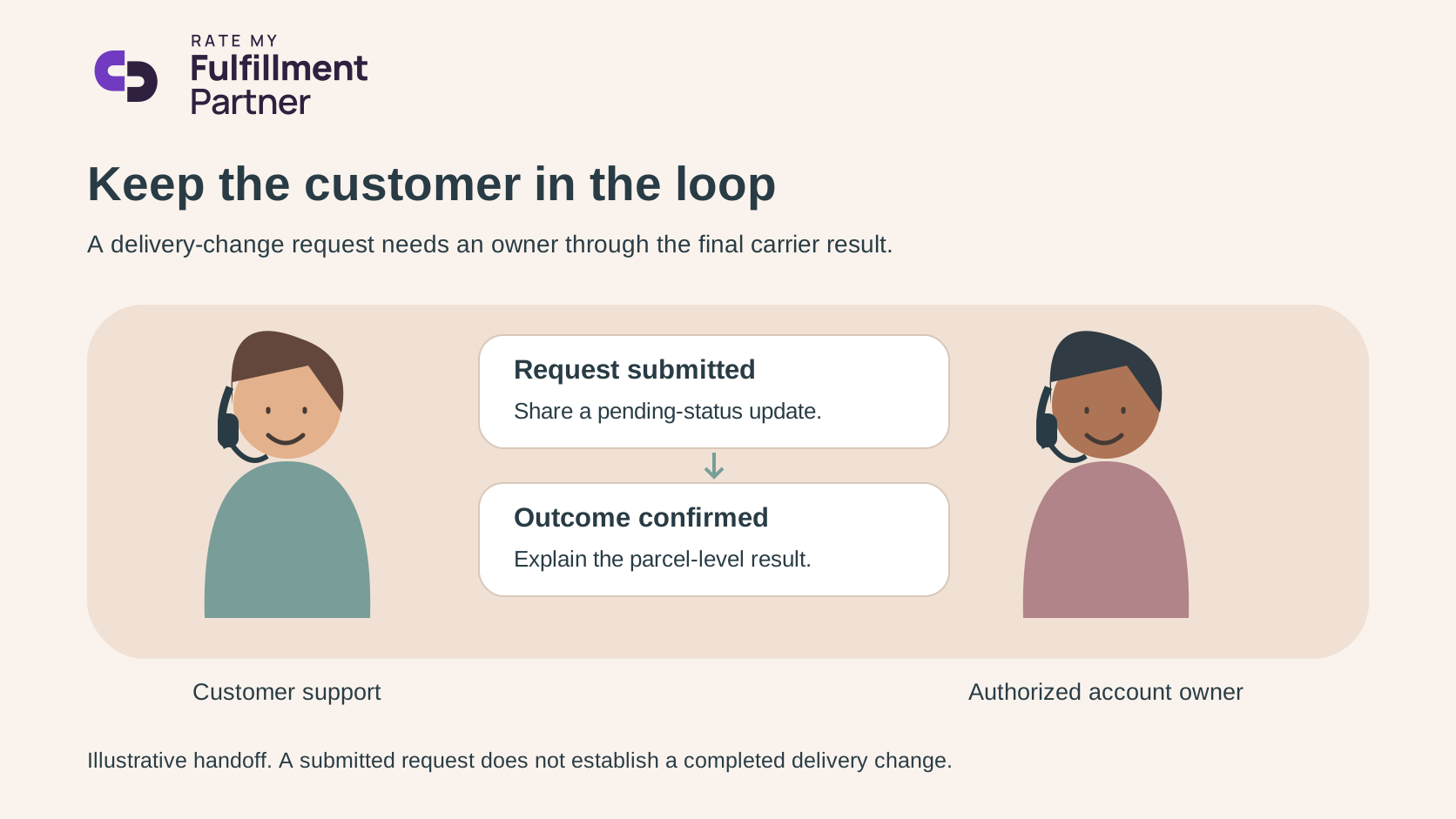
“We changed it” can mean two different things A customer notices an old address after shipment. Support updates the storefront. The warehouse sees the new address on screen. Neither action, by itself, demonstrates a changed destination for the parcel already in transit.
This is a useful service-quality question when evaluating a 3PL: can the team explain the handoff between the order record and the carrier's delivery process? Ask for a walkthrough using a fictional shipment, not somebody else's customer data.
Use the carrier option that actually applies For eligible U.S. shipments, UPS describes Delivery Intercept options including rerouting, returning to sender, rescheduling and holding for pickup. Requests must precede delivery; eligibility matters, and fees may apply when a request is completed. These are UPS's stated options, not a promise that every parcel can be changed. UPS Delivery Intercept.
Other carriers and account arrangements can differ. The practical first question is who controls the shipping account and has authority to make the request. A brand should not discover during an urgent ticket that its 3PL and support team each expect the other to act.
Test four states instead of one success story We constructed a four-state desk checklist from the distinction between requesting a change and completing it. It is an editorial evaluation tool, not a test performed on any provider.
| State shown in the exercise | Evidence to request | Customer message should convey |
|---|---|---|
| Customer asks for change | Verified request and original tracking reference | The request has been received |
| Authorized account user submits it | Submission reference, timestamp and requested action | The carrier request is pending |
| Outcome is confirmed | Carrier result tied to that parcel | What changed and what remains uncertain |
| Change cannot be completed | Recorded outcome and next decision owner | Available next steps without promising a reroute |
A submission receipt belongs in the second row, not the third. This small distinction prevents a friendly acknowledgment from becoming an unsupported delivery promise.
Decide the money and communication rules in advance Agree who may authorize a charge and what happens if the customer changes their mind. Keep carrier charges separate from any 3PL administration fee; obtain the applicable terms instead of assuming the carrier fee is the whole bill.
Give support a named owner, a next-update time and a clear escalation route when the owner is unavailable. The update can honestly say that a result is pending. Silence is not required just because the outcome is unknown.
For a hypothetical two-parcel order, suppose one reroute completes and the other does not. There are two parcel outcomes, even though there is one customer ticket. The message should identify both, and the resolution policy should address the unsuccessful parcel separately. Do not turn one successful tracking event into a whole-order success.
What a strong partner can show Look for a repeatable handoff with recorded authority, parcel-level references and a person responsible through the final result. A polished support dashboard is helpful, but the buyer's real requirement is simpler: nobody should mistake an internal edit for a changed delivery.
Further reading
Sources
- Source 1 — accessed 2026-10-28.